Is St Peters Chancel skewed or
canted?
This plan below is taken
from a description of Goldhanger in The
1922 Inventory of the Historical Monuments in Essex and shows a strangely
angled north wall of the Chancel. This plan is still available in...
https://www.british-history.ac.uk/rchme/essex/vol3/pp105-107
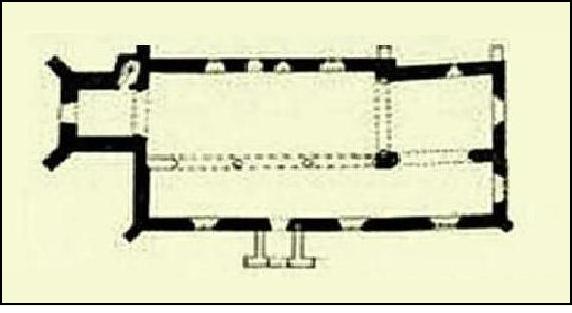
It is not obvious today
if the north wall of the Chancel lines up with the other walls of the Church.
However if the Chancel walls are, or were, at a different angle St Peters Nave
this is apparently not unique, as many other ancient churches in the UK have
similar angled chancel walls and the phenomenon has been extensively
researched, including in a 2004 paper entitled “Do Chancels Weep?”
by Dr Ian Hinton of the University of East Anglia,
who investigated 1000 rural medieval UK churches and determined that 218 had
mis-aligned chancel walls, 45 were very similar to
Goldhanger, and 25 of those are called St Peter!
his
paper is at... https://www.researchgate.net/publication/271523225_Church_Archaeology
(some of the information on this page has been
taken from this paper)
The phenomenon has been
given various names in the past, the most common being Weeping Chancel. This name originates from 11th and 12th centuries
when it was believed that it replicated Christ's head resting on his right
shoulder in death. The majority of historians now however believe that that
there are other more practical explanations but the name to has persisted. A
modern architectural term frequently used is canted, which means “set at an angle”.
The simple explanation for the Chancel walls being at a different angle today is that they
were built, or rebuilt, at a different time to the other parts of the Church
and a different alignment was deliberately chosen. In many churches with this phenomena
all three or even four of the wall are at different angles, but in the 1022
plan above St Peters it seems to have been only the north wall has or had a
significantly 6 degree different angle,
the east wall aligns with all the other walls and the south has a very
slight 1-2 degree difference.
Although early stone
masons and builders were clearly very keen on having a church pointing towards
Christ’s birth place in Jerusalem in reality at the time they had very little
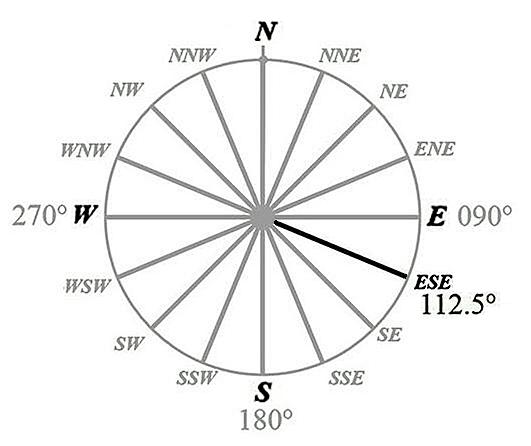
idea in which direction that actually was – we now know it is nowhere near east
from the UK and is in fact well south of the east, making it nearer East South
East.
There are two pieces of
evidence in the Church today that suggest the Chancel was re-built in the
past...
An explanation for the
north wall being different at St Peters is revealed in Goldhanger – an Estuary Village, written by Maura Benham…
There was either a doorway or an alcove in
the north wall of the chancel. Parts of a stone surround resembling a door were
revealed during replastering of the interior in 1976, and the space was filled
with narrow bricks of the Tudor period. One may wonder why it was closed up.
Its position in the north wall of the chancel suggests that it could have been
an alcove used as an Easter sepulchre, possibly incorporating a tomb.
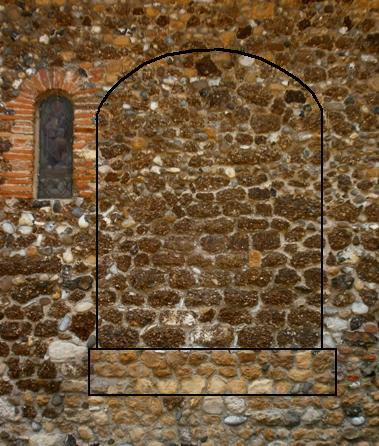
This
suggests that the north wall of the Chancel was re-built at some time in the
past and this might account for why this wall is, or was, at a different angle.
and
from... List of Buildings of Special Architectural or Historic Interest, dated
1985:
“...possible
14th century carving of a man, angel with ivy leaves and a small animal”
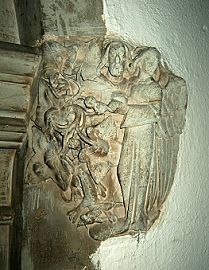
This lonely stone carving on the south wall of the Chancel
suggests that this wall has also been re-built.
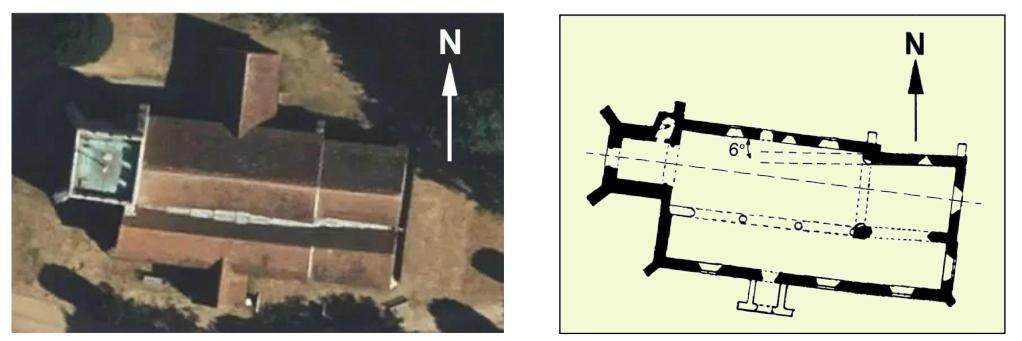
Below
is a current satellite view of St Peters that demonstrates that the Church
is nowhere near east-west aligned and is fact about 6 degrees off that
alignment and by adjusting the same plan shown above to this angle shows that
the Chancel north wall was more aligned to the east and the Nave is more
aligned to towards Jerusalem....

The most plausible
explanation given was the way in which east was once determined. Some say in
earliest times the mid Summer Solstice was used. Another theory suggests that
it was based sighting the rising sun on the morning of Easter Sunday. A
magnetic compass has also been used for centuries, and it is now known that
magnetic north has moved significantly over the centuries as show on this
graph...
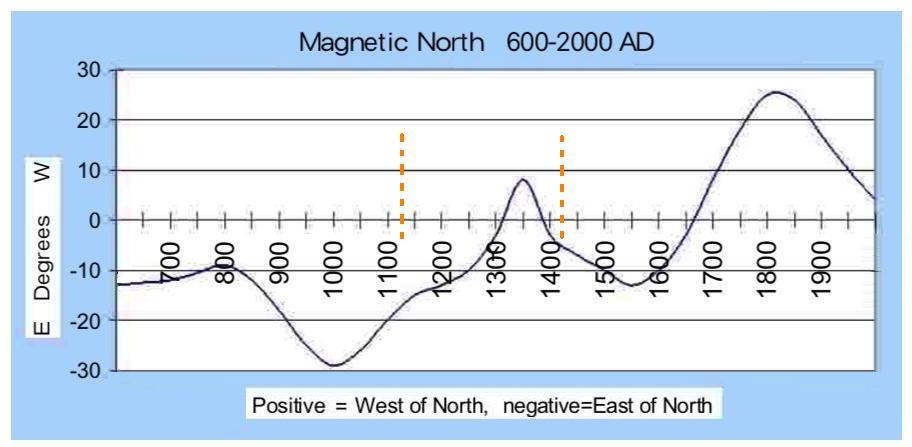

The period between the
red lines is most likely to have been when St Peters and many other Naves and
Chancels were built, and magnetic north moved significantly over that period.
It can also be seen that in the years 1300 and 1400 magnetic compasses would
have shown a much truer polar north and hence a true east.
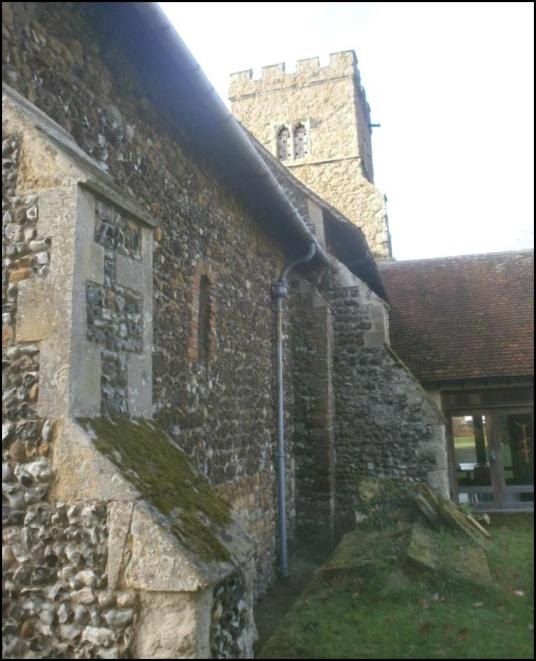
Today the outside of the
north wall is a complex scene looking like this recent view and the exact
angles of the walls are very difficult to judge because of the large
buttresses...
The
inside walls on both the north and south side of the Chancel
are a easier to study and assess as photos can be taken looking along the
Nave...
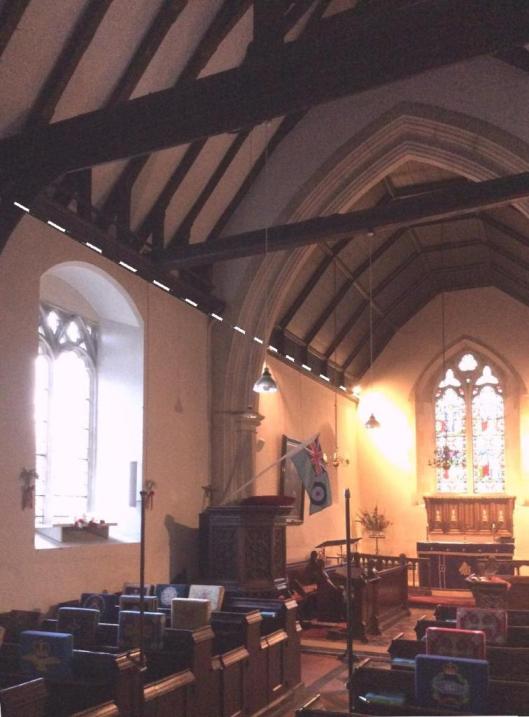
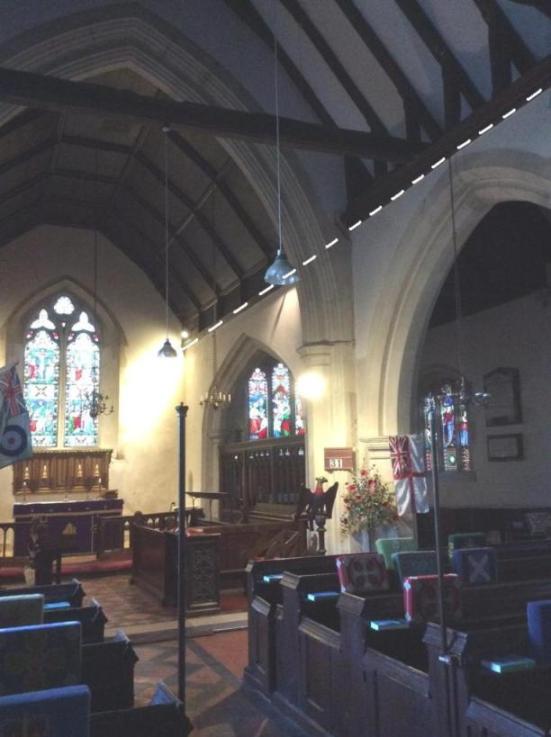
Dotted
lines that have been added to these images and show a small difference between
the angles in the Chancel
to those in the Nave, perhaps only of
2 or 3 degrees.